What Is Petty Cash?
Petty cash is a small amount of money kept on hand for minor, everyday business expenses — things like office supplies, parking, or a quick lunch for a working meeting. It's meant to cover costs that are too small or inconvenient to run through a formal payment process.

Why Is It Important to Manage Petty Cash Properly?
Petty cash might be "petty," but the problems that come from mismanaging it are anything but. Without proper controls, petty cash funds become a black hole: money disappears with no paper trail, reconciliation becomes a guessing game, and small losses compound into meaningful ones over a year.
Beyond the dollars, mismanaged petty cash erodes trust. When employees know a fund is loosely controlled, the temptation for misuse grows. Employees may see ambiguity and lack of controls, and it might tempt a portion of them. A clear, consistently enforced process protects both your business and your team.
Good petty cash management also pays dividends at tax time. Documented, categorized expenses are deductible. Undocumented ones aren't.
How to Track and Audit Petty Cash Effectively
Here are the best practices for managing petty cash in your business, so you can keep it organized and avoid headaches down the line.
Keep It Physically Secure
Store petty cash in a locked drawer, cash box, or small safe. Access should be restricted to authorized personnel only. If multiple people need access, consider a key log or a combination shared only with those who need it. Physical security is the first line of defense — if anyone can reach in, you'll never know who did.
Set a Clear Petty Cash Policy
A written policy is non-negotiable. Without it, every employee is operating on their own interpretation of what's allowed. A solid policy covers:
- Purpose: What is the fund for? List the types of expenses it's meant to cover — and equally important, what it's not for.
- Fund size and replenishment: How much should be kept on hand? At what balance does the fund get replenished, and who authorizes that?
- Per-transaction limits: Set a ceiling (e.g., no single expense over $50) to prevent the fund from being used for purchases that should go through accounts payable.
- Documentation requirements: Require a receipt or a signed voucher for every withdrawal. No receipt, no reimbursement — no exceptions.
- Reconciliation schedule: Define how often the fund is reconciled (weekly is common) and who is responsible.
- Roles and access: Spell out who can withdraw funds, who can add to the fund, who holds the keys, and who conducts audits. Separate the person or people who can access the fund from the person who audits it.
- Discrepancy handling: What happens when the count is off? Require written explanations for any variance, no matter how small.
Set Up a Tracking System for Every Transaction
Every dollar that goes in or out of your petty cash fund needs a record. Here's how the options stack up:
Pencil and paper is where most small businesses start. A simple log with columns for date, amount, purpose, and recipient works fine when you have one location and a handful of employees. The problem is that paper logs are easy to lose, too easy to change, hard to search, and impossible to share across a team. They also require manual counting to spot discrepancies.
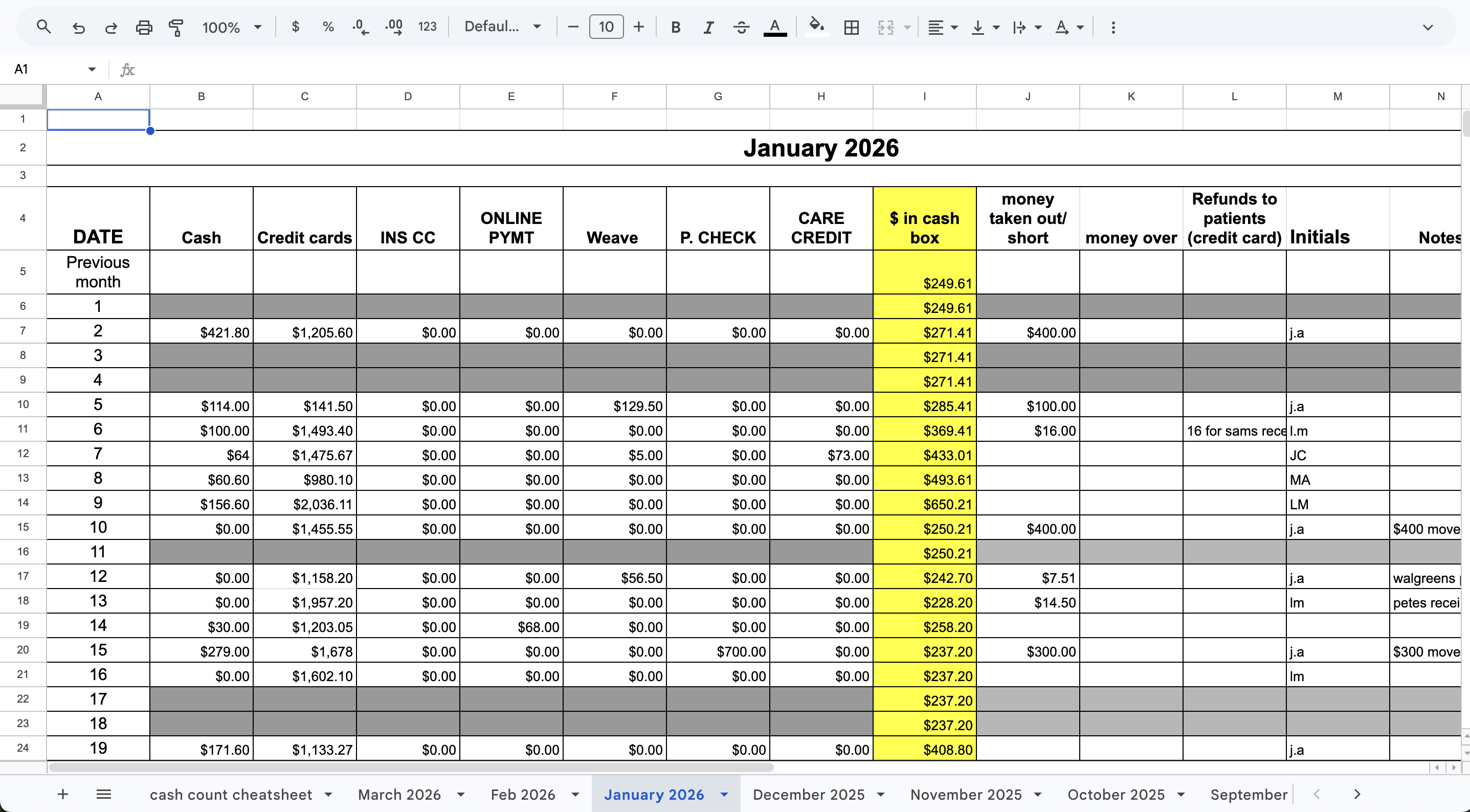
Spreadsheets are a natural next step. They're essentially free, flexible, and most employees already know how to use them. But as your business grows, spreadsheets become fragile. Version control is a nightmare when multiple people are editing. There are no built-in approval workflows, no automatic alerts when the balance drops, and no audit trail showing who changed what and when.
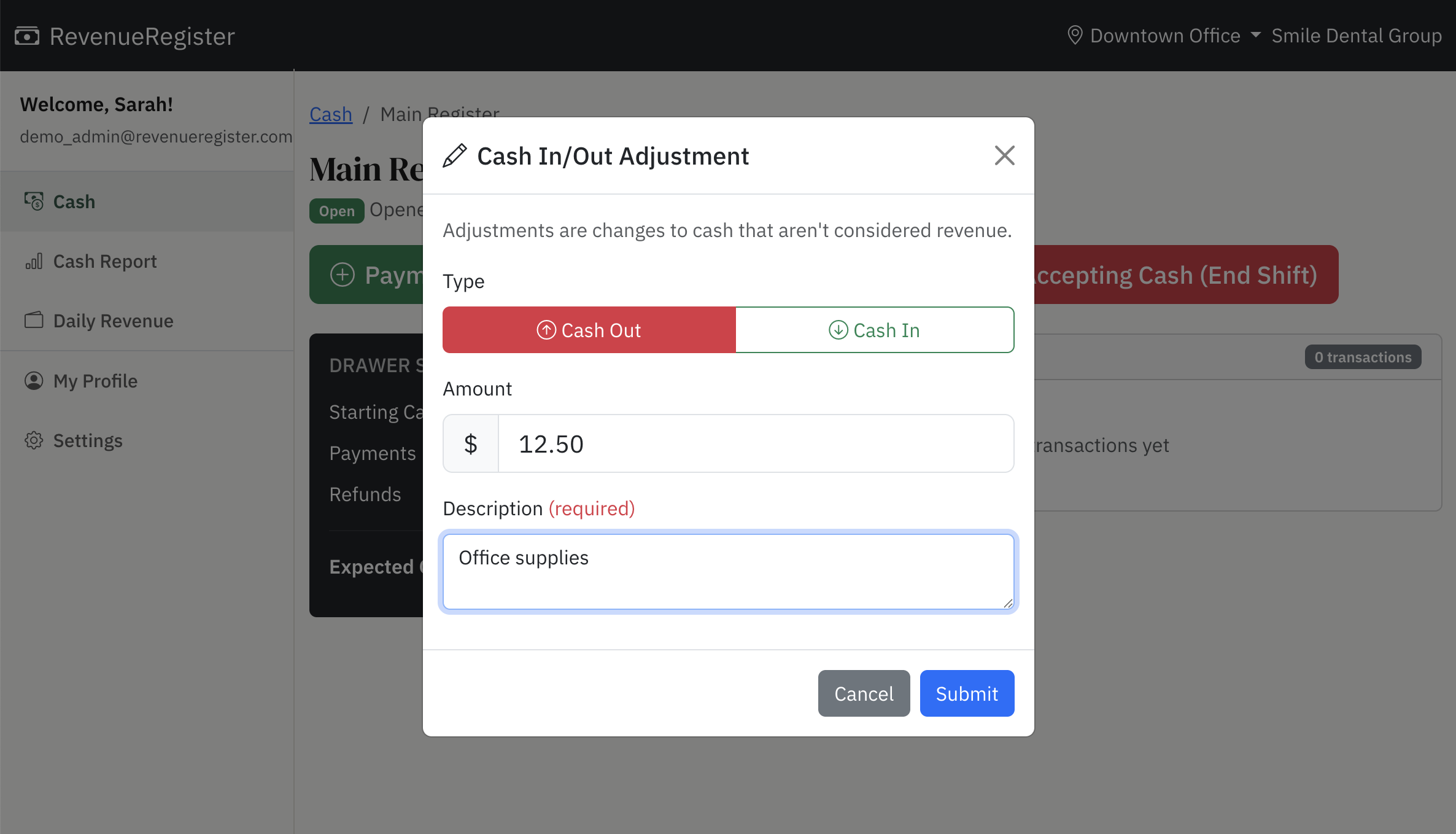
RevenueRegister is built for exactly this. It is a software application where employees track cash transactions. Every petty cash transaction is logged with a timestamp, employee name, amount, and comments. The fund balance updates in real time, even across multiple screens. Managers can see every entry from any location, and the reconciliation report is generated automatically. Instead of hunting through a binder or a shared Google Sheet, you get a clean, searchable record of every dollar — with built-in controls that paper and spreadsheets simply can't match.
Train Your Team Before Going Live
A policy only works if people follow it — and people only follow what they understand. When you roll out or update your petty cash process, train every employee who will interact with the fund.
Effective training covers:
- How to request a withdrawal
- What documentation is required
- How to submit receipts
- What happens if there's a discrepancy
If you're using RevenueRegister, take advantage of Test Mode. New employees can practice opening drawers, recording transactions, and running reconciliations against a sandbox fund — without touching real money. Once they're comfortable, flip the location to Live Mode and they'll hit the ground running with zero risk of errors during onboarding.
Reconcile Regularly — and Investigate Every Discrepancy
Reconciliation means comparing the physical cash in the fund against the running log of transactions. The two should always match. If they don't, find out why before replenishing.
Regular reconciliation — weekly for most businesses, daily for high-volume locations — catches problems while they're still small and traceable. A $5 discrepancy found on Friday is much easier to resolve than a $200 gap found at month-end.
RevenueRegister takes the friction out of this process. When a drawer is closed at the end of a shift, the system prompts staff to enter their physical count. Any variance is flagged immediately and requires a written comment before the session can close. That comment becomes a permanent part of the audit trail — so managers always know what happened, when, and who signed off on it.
Use Reporting to Spot Trends and Enforce Compliance
Reconciliation tells you if today's count is right. Reporting tells you whether your petty cash policy is actually working over time.
RevenueRegister's Cash Report gives you both summary-level and transaction-level visibility into petty cash usage across every location, drawer, and employee. You can see which categories are driving spend, which locations are running through funds faster than expected, and whether any individuals are making unusually frequent or large withdrawals. Use these reports in regular management reviews to catch policy drift before it becomes a real problem.
Common Mistakes to Avoid
Not Having a Written Policy
This is the root cause of most petty cash problems. Without a written policy, "rules" exist only in someone's head — and they change depending on who's managing the fund that week. When employees don't know what's allowed, they fill in the gaps themselves, usually in ways that don't serve the business. Write it down, review it annually, and make sure every employee who touches the fund has read and acknowledged it.
Relying on Pencil and Paper for Too Long
Pen-and-paper logs are fine when you have one register, one location, and two or three employees. Past that point, the cracks show fast. Logs get lost. Handwriting is illegible. There's no way to tell if an entry was altered after the fact. And when an auditor asks for records from six months ago, good luck finding the right spiral notebook. The moment your business starts to grow, it's time to move to a system that scales with you.
Relying on Spreadsheets for Too Long
Spreadsheets feel like an upgrade from paper — and they are, for a while. But they're still manual, still error-prone, and still fundamentally a single-user tool. When multiple employees are logging transactions across multiple locations, spreadsheets become a coordination problem. There's no employee-level audit trail, no automatic balance alerts, no reconciliation workflow, and no way to prevent someone from editing or deleting past entries. A dedicated tool like RevenueRegister gives you all of that out of the box, without requiring a finance degree to set up.
Letting the Fund Go Unreconciled for Too Long
Skipping reconciliation for weeks at a time is like ignoring a slow leak — by the time you notice, the damage is already done. Gaps that go uninvestigated become impossible to trace. Make reconciliation a non-negotiable part of your weekly operations, not something that happens whenever someone gets around to it.
Mixing Petty Cash With Other Funds Without Documentation
Some businesses choose to mingle petty cash with cash from operations. This is fine, so long as you have proper accounting systems to document whether cash movement is revenue, refunds, or petty cash adjustments. This is exactly where RevenueRegister shines — it allows you to track all cash movement in one place, with clear categorization and a full audit trail. If you choose to commingle, make sure your system can handle the complexity and that your team is trained to categorize every transaction correctly. Otherwise, you're asking for trouble when it comes time to reconcile, file taxes, or audit.
Frequently Asked Questions
What is a petty cash drawer?
A petty cash drawer (or petty cash box) is the physical location where you store the petty cash fund — typically a locked cash box or a dedicated drawer in a safe. It holds the cash itself along with any receipts or vouchers for recent transactions that haven't yet been logged. The term is sometimes used interchangeably with "petty cash fund."
How much should I keep in petty cash?
Most small businesses keep between $100 and $500 in their petty cash fund. The right amount depends on how frequently you use it and for what. Start by looking at a month of small, cash-type expenses and size the fund so it needs replenishment no more than once or twice a month. Too small and it's a constant nuisance to refill; too large and you're exposing yourself to unnecessary risk.
How do I track petty cash expenses?
Require a receipt or signed voucher for every transaction. Log each one immediately — don't let receipts pile up. Record the date, amount, expense category, and the name of the person who made the purchase. Reconcile the fund on a fixed schedule and investigate any discrepancy before replenishing. A tool like RevenueRegister automates most of this, so the tracking happens as a natural part of opening and closing the drawer rather than as extra paperwork.
What are some common petty cash policies?
Common policy elements include: a maximum fund balance (e.g., $200), a per-transaction limit (e.g., no single expense over $50), a requirement for a receipt on every withdrawal, a designated custodian responsible for the fund, a weekly reconciliation requirement, and a list of approved expense categories (office supplies, postage, parking, small tools, etc.). Some businesses also require a second signature for withdrawals above a certain threshold.
Ready to Put This Into Practice?
RevenueRegister gives your team a structured, auditable petty cash workflow from day one — across every location, every drawer, every shift.
Start Your Free 14-Day Trial